How to Shorten a Necklace That Is Too Long (Without Ruining It)
The chain is beautiful and it sits three inches too low. Somewhere on the internet, someone is about to tell you to take wire cutters to it.
Do not do that yet. There are five ways to make a necklace shorter that leave the chain exactly as it was, and for most chain types they are also the only ways that end well. Here is the honest order to try them in.

Start Here: Put the Wire Cutters Down
The single most important thing to know before you shorten anything: a cut chain is never as good as it was. That is not us being precious about it — it is the trade's own position. Jewelers of America puts it flatly: a chain after being repaired is never as strong as it was before it was broken, and on very small or lightweight chains you can end up with stiffness in the surrounding links.
That applies whether the break was an accident or you made it on purpose with a pair of pliers. Every join is a weak point, and a join you squeezed shut with household tools is a weak point that will open again — usually while you are wearing it, usually somewhere you will not notice until the chain is gone.
So the order of operations is:
- Reversible and free — the clasp trick, doubling, layering
- Reversible and cheap — a chain shortener clip or an adjustable extender
- Permanent and correct — a jeweller removes links and solders the join
- Permanent and risky — you remove links yourself, on a chain you can afford to lose
Most people asking how to shorten a necklace can stop at step one or two. The rest of this page is about knowing which step you are actually at.
How to Shorten a Necklace Without Cutting It
This is what most people actually want, and it is genuinely the right answer more often than not. If you are searching how to make a necklace shorter without cutting it, or how to make a long necklace shorter without a trip to the jeweller, these five are the whole list — roughly in order of how well they hold up.
1. Clasp into a different link
The oldest trick and still the best free one. Instead of closing the clasp onto the end ring, bring it forward and clasp it onto a link further along the chain. The excess hangs down at the back, and on a long chain it disappears under a collar entirely.
Works on: cable, curb, figaro, belcher, most link chains where the clasp physically fits through a link. Does not work on rope, snake, herringbone or box chains, where there is no open link to hook into.
2. A chain shortener clip
This is also the answer to how to make a necklace shorter without a clasp. Continuous chains with no fastener cannot use the trick above, because there is nothing to hook through a link — but a shortener clip grips the chain itself, so it does not care whether a clasp exists.
A small clasp-like device — sometimes a magnetic disc, sometimes a hook — that grips two points on the chain and holds the slack in a loop. It costs very little, takes two seconds, comes off whenever you like, and does not touch the chain's structure. For most people this is the answer.
3. Double it up
If a chain is roughly twice the length you want, wear it doubled. A 32-inch chain becomes a snug 16-inch two-strand piece, which reads as deliberate rather than as a compromise. This suits fine cable chains far better than heavy cuban links, which get bulky fast.
4. Wear it differently
How to make a long necklace look shorter, without touching it at all: layer it. Put a shorter chain above it and the long one stops looking long — it becomes the bottom tier of a stack. This is the honest answer for a lot of chains, and it is why we cover necklace lengths separately, because the piece may not be too long so much as sitting alone.
5. Knot it
Listed for completeness, with a warning. A knot shortens a chain instantly and it is free. It also kinks the links permanently, and on a fine chain a knot is a stress point that will eventually snap. Fine for a costume piece or one night. Never on anything you care about, and never on a snake or herringbone chain, which will crease and never recover.
Every option above is reversible. Every option below this line is not. If the necklace is sentimental, precious metal, or expensive, the reversible ones deserve a genuine try first — you can always cut it next week, but you cannot uncut it.

Which Chains Can Be Shortened, and Which Cannot
This is the part almost every guide skips, and it is the part that decides whether your chain survives. Chain construction is not universal. Some chains are made of discrete links you can open and close. Others are woven, articulated or hollow structures where "removing a link" is not a coherent idea.
Jewelers of America notes that the chains most difficult to repair, because of their complexity, include rope and cable chains and herringbone chains. Difficult to repair means difficult to shorten, for exactly the same reason: you are cutting into a structure that was built continuous.
| Chain type | DIY shortening? | Why | What to do instead |
|---|---|---|---|
| Cable / belcher | Possible | Simple open links, easy to identify and open | Clasp trick first; jump ring if you must cut |
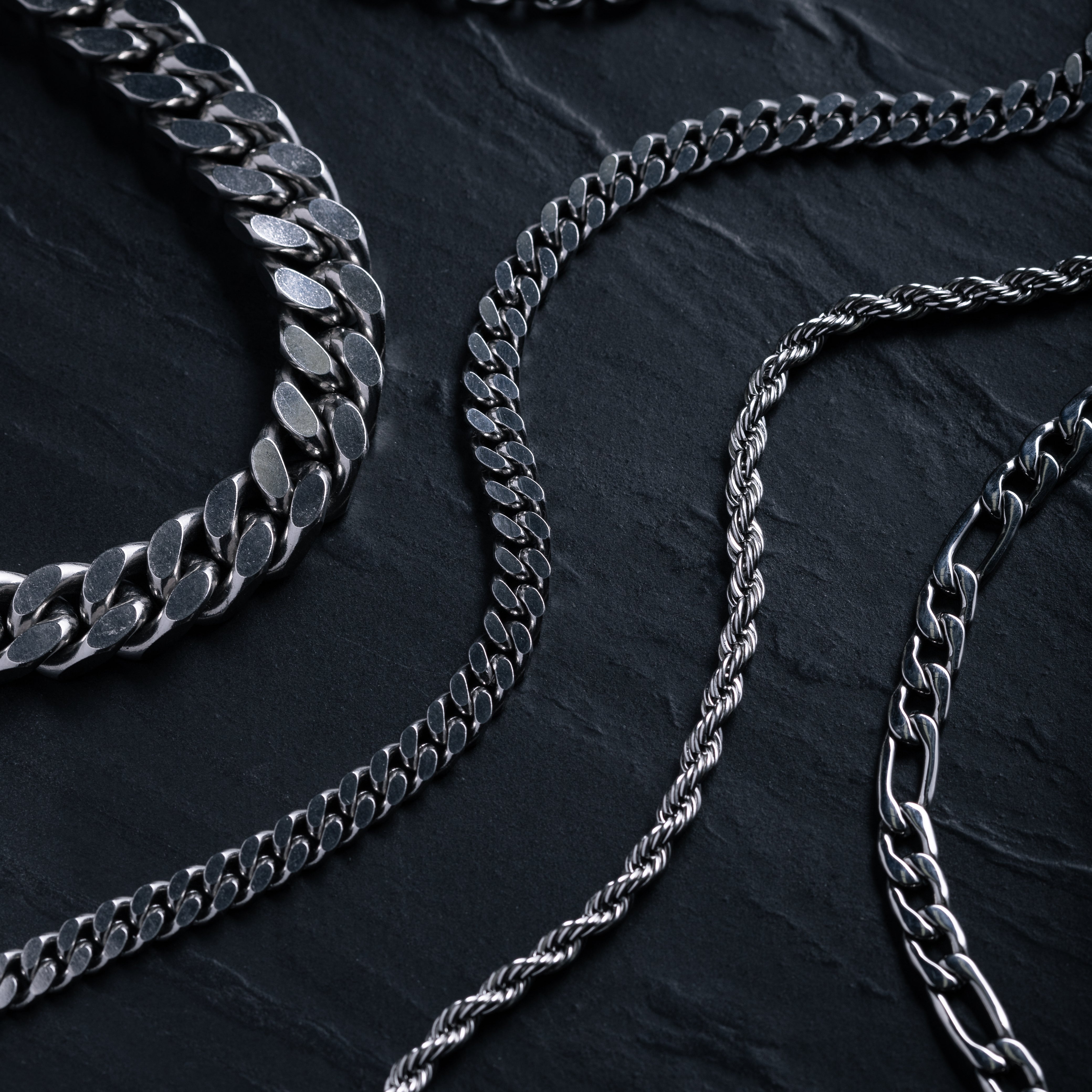
| Curb / cuban | Possible, harder | Links are twisted and often soldered shut | Jeweller — the join shows if done badly |
| Figaro | Possible, with care | The pattern repeats, so cutting anywhere breaks the rhythm | Remove a whole pattern repeat, not part of one |
| Rope | No | Tiny interlocking links woven in a spiral. Cut it and it unravels | Jeweller only, or a shortener clip |
| Snake | No | A continuous articulated tube. There are no links to remove | Shortener clip, or replace |
| Herringbone | No | Flat woven blades that kink permanently under any stress | Jeweller only. Do not knot or bend it |
| Box | Rarely | Square links seat into each other; a hand-closed join sits proud | Jeweller |
| Hollow chains | No | Thin walls crush under pliers and melt under a torch | Jeweller, and tell them it is hollow |
So can a rope chain be shortened? Yes — but not by you, and not with pliers. Can you shorten a rope chain at home? Genuinely, no. The spiral is what gives a rope chain its look, and cutting it releases the tension holding that spiral together. This is the single most common way people destroy a chain trying to save a jeweller's fee, and it is why how to make a rope chain shorter — or how to make a rope necklace shorter, same thing — has a different answer to every other chain on this list: take it in, or clip it.
Chain Shorteners, Extenders and Clips
If you want a hack, this is the one worth knowing, and it is also the answer to how to make a necklace shorter temporarily. A chain shortener is a small piece of hardware that gathers slack without altering the chain. They come in a few forms and they are the most underrated fix on this page.
| Type | Best for | How it works |
|---|---|---|
| Shortener clip | Any chain, any length | Hooks two points of the chain together, slack loops at the back |
| Magnetic shortener | Fine and mid-weight chains | Two magnetic discs pinch the chain at your chosen point |
| Extender chain | Chains that are too short | The reverse problem — adds 2 to 4 inches. Worth knowing exists |
| Adjustable slider | Chains bought with one fitted | A bead that grips the chain and slides to any length |
The catch is honesty about heavy chains. A magnetic shortener on a heavy cuban link will not hold — the weight beats the magnet and you lose the necklace. Match the hardware to the chain, and on anything substantial use a mechanical clip rather than a magnet.
Removing Links, If You Really Must
If the chain is a simple cable or belcher, it is inexpensive, and you accept it will not be as strong afterwards, this can be done. Read that sentence again — all three conditions, not one.
This is the only section that answers how to make a chain necklace shorter permanently at home, and the same steps cover how to make a necklace chain shorter on the simpler link types. What you need: two pairs of flat-nose or chain-nose pliers (not wire cutters), a jump ring or two in matching metal, and good light. Then:
- Measure with it on. Hold the chain at the length you want and mark the link with a scrap of tape. Do not measure it flat on a table and guess — necklaces sit differently on a body.
- Work out which links come out. Count from the clasp end so the pattern stays symmetrical. Remove from one end, not the middle, or the clasp ends up off-centre.
- Open a link, do not cut it. Grip either side with the two pliers and twist one side sideways — laterally, not outwards. Pulling a link open widens it permanently and it will never close true.
- Rejoin with a jump ring, or solder it. This is the step everyone gets wrong. A link twisted shut by hand is a gap waiting to happen. A soldered join is the only genuinely permanent fix, and that means a torch.
- Test it hard, at home. Pull firmly on the join over a table before you wear it out. Better to find the weak point over your kitchen than over a train platform.
Worth knowing before you alter anything precious. Under the UK's Hallmarking Act 1973, it is an offence to make an addition, alteration or repair to an article bearing approved hallmarks except with the written consent of an assay office — and an article that has been improperly altered counts as unhallmarked. The assay offices call this a change of use, and they will re-examine and re-mark a piece so it stays compliant.
In practice nobody is coming for your necklace. But if you ever want to sell a hallmarked piece, a DIY alteration can cost you its legal status — which is a real reason to let a jeweller handle anything marked.
When to Just Pay a Jeweller
Whether you are working out how to make a gold necklace shorter, how to make a pearl necklace shorter, or how to make a beaded necklace shorter, the answer converges on the same place. Hand it over without hesitating if any of these are true:
- It is rope, snake, herringbone, box or hollow. There is no home method that works.
- It is gold, or solid silver you like. The metal is worth more than the fee.
- It is sentimental. Obvious, routinely ignored.
- It has a pendant that must stay centred. Take length off both sides evenly, which is fiddly to get right.
- It is hallmarked. See above.
What a jeweller does that you cannot: cut cleanly, remove the right section, reattach the clasp end, and solder the join so it is a join rather than a gap. Then polish it so the repair is invisible. On most chains this is a quick, inexpensive job — and shortening is one of the more routine things they are asked for.
Ask two things when you drop it off: whether the chain type can be shortened cleanly at all, and whether the join will be visible. A good jeweller will tell you straight if the answer is bad, especially on herringbone.
Mistakes That Ruin Chains
Every one of these is common, and every one is avoidable.
- Wire cutters. They crush and deform the link rather than parting it cleanly, and they leave a sharp burr that catches on clothing and skin. This is the mistake this page exists to prevent.
- Pulling links open outwards. It widens the ring permanently. Twist laterally instead.
- Squeezing a cut link shut and calling it done. That is not a repair, it is a countdown.
- Measuring flat. A chain measured on a table is not the length it wears at, especially with a pendant.
- Cutting from the middle. The clasp ends up round the side of your neck.
- Doing it while the chain is on you. Obvious, and yet.
- Cutting before checking the type. One cut into a rope or herringbone chain is the whole chain.
If you want the length right from the start next time, our guide to measuring a chain necklace covers how to get it right before you buy, and the sizing guide has the numbers.

Frequently Asked Questions
How do I make a necklace shorter?
How do you shorten a necklace without cutting it?
Can you shorten a rope chain?
What is a chain shortener?
How do you make a chain smaller?
Can I shorten a necklace myself?
How much does a jeweller charge to shorten a necklace?
How do you shorten a necklace temporarily?
How do you make a pearl necklace shorter?
How do you make a beaded necklace shorter?
How do you make a gold necklace shorter?
How do you make a long necklace look shorter?
The Bottom Line
Almost nobody needs to cut their necklace. Clasp it onto a different link, clip a shortener on the back, double it, or layer it — four free or nearly free fixes that leave the chain exactly as it was. If it has to be permanent, work out your chain type first, because rope, snake, herringbone and hollow chains do not survive home surgery, and a hand-closed join on any chain is a weak point you will meet again later.
When in doubt, a jeweller does in ten minutes what wire cutters do permanently. Browse our necklaces and cuban link chains, or the full collection.