Types of Gold Jewelry: The Complete Guide to Colors, Karats & Quality

To understand the different types of gold, you first have to understand that gold in its natural state is almost useless for jewellery. Pure gold is soft. If you made a wedding ring out of 100% gold, you might bend it out of shape with a firm handshake. It scratches if you look at it the wrong way.
Because of this, almost all gold jewellery is an alloy. An alloy is simply a mixture of metals, which may include various types of gold. We take pure gold and mix it with harder base metals, such as copper, silver, nickel, or zinc. This accomplishes two things: it makes the metal durable enough to hold a diamond or survive daily wear, and it allows us to change the colour.
Why does this issue? Because the ratio of gold to other metals is exactly what determines the value. When you buy a piece, you are paying for the gold content. If you do not understand the karat system or the difference between "gold filled" and "gold plated," you are flying blind.
What are the different types of gold ore?
When exploring the types of gold, geologists commonly distinguish between lode (vein) deposits and placer (alluvial) deposits; lode gold is found within rock as quartz-hosted veins, sulphide-associated ores or refractory telluride minerals, while placer gold occurs as free or nugget-like particles concentrated in streambeds and gravels. Other practical categories include oxide versus sulphide ores, which affect processing methods, and free-milling gold, which can be recovered by gravity or cyanidation, versus refractory gold, which requires roasting or biooxidation to liberate the metal. Knowing these types of gold helps determine the best mining and extraction techniques for a given deposit.
Understanding Types of Gold Karat and Purity
The term "karat" (often abbreviated as k, K, or kt) is the standard measurement of gold purity. It is a basic fraction out of 24.
- 24k Gold: This is 24 parts gold out of 24. It is 99.9% pure.
- 18k Gold: This is 18 parts gold and 6 parts alloy. It is 75% gold.
- 14k Gold: This is 14 parts gold and 10 parts alloy. It is 58.3% gold.
- 10k Gold: This is 10 parts gold and 14 parts alloy. It is 41.7% gold.
The higher the karat, the more "gold" the piece contains, which means it is softer, heavier, and more yellow. The lower the karat, the harder and cheaper it is, but it may be more prone to tarnish depending on the other metals used.
24k Gold (The Pure Standard)
Solid 24k gold is rarely used for jewellery in the West because it is simply too soft. It has a rich, intense orange-yellow colour that looks almost fake if you are used to 14k. In parts of Asia, 24k and 22k are the standards for investment jewellery because the value lies in the metal's weight rather than the design. You can push a fingernail into 24k gold. I advise against it for rings or bracelets that you plan to wear daily.
18k Gold (The High-End Balance)
18k gold is the sweet spot for fine jewellery. It contains 75% gold, which gives it a reassuring weight and a warm, rich tone that resists tarnish well. It is softer than 14k, so it will scratch over time, but it holds up well enough for engagement rings if you are careful. If you have metal allergies, 18k is a safer bet than lower karats because there are fewer base metals to irritate your skin.
14k Gold (The Workhorse)
In the US, 14k gold is the most common choice for wedding bands and engagement rings. At 58.3% gold, it is significantly harder than 18k. It resists scratching and warping much better. The yellow colour is slightly less intense, appearing more "straw-colored" than the deep buttery yellow of 18k. For an active lifestyle, 14k is often the right type of gold.
10k and 9k Gold (The Budget Options)
10k is the lowest karat legally sold as "gold" in the US. In the UK and Australia, 9k (37.5% gold) is standard. These alloys are very hard and durable, but because they contain more copper and silver than gold, they are more likely to tarnish eventually. They also lack the lustre of higher karat gold, making this type of gold jewellery less desirable. If you are on a tight budget, 10k is a solid option, but do not expect it to look exactly like a museum piece.

Colours of gold: How alloys change the look
Gold is naturally yellow. The only way to get white gold, rose gold, or green gold is to mix it with other metals. The karat tells you the percentage of gold; the colour tells you what that gold was mixed with.
Yellow Gold
Yellow gold is the most traditional form. It is created by mixing pure gold with equal parts silver and copper, usually with a bit of zinc.
- The look of this gold piece is enhanced by its karat level. Warm, classic.
- Pros: It is the most hypoallergenic colour (usually requires no nickel). It requires the least maintenance.
- Cons: It can look dated in certain settings, though it has seen a recent resurgence.
White Gold
White gold offers a modern, silvery look that competes with platinum but at a lower price point. White gold is created by alloying pure gold with white metals like nickel, manganese, or palladium.
- The catch: Even mixed with white metals, gold wants to be yellow. "Raw" white gold actually looks slightly yellowish-grey. To fix this, the jewellery is typically rhodium-plated. Rhodium is a platinum-group metal that is bright white and very hard.
- Maintenance: That rhodium plating wears off. Depending on how much you rub the ring (wearing it next to another ring speeds this up), you will need to get it "dipped" or re-plated every 1 to 3 years. If you don't, the yellowish colour will start to show through at the bottom of the shank.
Rose Gold
Rose gold has become incredibly popular in the last decade. The pinkish hue is created by increasing the copper content in the alloy.
- The recipe: A common 18k rose gold mix is 75% gold and 25% copper. For a lighter pink, a bit of silver is added.
- Durability: Because copper is a very hard metal, rose gold is actually tougher than yellow or white gold of the same karat.
- Cons: Copper is not hypoallergenic. If you have a copper allergy, avoid rose gold.
Green, Black, and Purple Gold
Yes, these exist, but they are rare.
- Green gold (Electrum) is made by mixing gold with silver and removing copper entirely. It has a greenish-yellow herbal look.
- Black gold is usually treated on the surface using oxidation or black rhodium plating. It is not black through and through.
- Purple gold is a unique form of gold used in some jewellery designs. It is an intermetallic compound with aluminium and is brittle like glass. You usually only see it used as an inlay, not for the structure of a ring.

Construction methods: Solid, Filled, and Plated
This is the area where people lose money. A "gold chain" might cost $50 or $5000. The visual difference might be slight at first, but the physical difference is enormous.
Solid Gold Jewellery
This means the piece is made entirely of the gold alloy described above. If you cut a solid 14k gold ring in half, it is 14k gold all the way through.
- Why it matters: It will never rub off. It can be polished, resized, and repaired. It has intrinsic value.
- Verdict: The best investment if you can afford it.
Gold Filled Jewellery
"Gold-filled" is a specific industry standard, mostly used in the US for jewellery pieces. It is not "filled" with gold; rather, a thick sheet of gold is mechanically bonded (melted/pressed) onto a base metal core (usually brass).
- The standard: By law in the US, the gold layer must be at least 5% of the total weight.
- Durability: This is much thicker than plating. Gold-filled jewellery can last 10 to 30 years without the brass showing through if you treat it well. It is a great middle-ground option.
Gold Vermeil Jewellery
Gold vermeil (pronounced ver-may) is a specific type of high-quality plating. For a piece to be sold as vermeil in the US, it must meet three conditions:
- The base metal must be Sterling Silver (not brass or copper).
- The gold layer must be at least 10k purity.
- The plating must be at least 2.5 microns thick. Vermeil is excellent for earrings or necklaces that do not get heavy wear. Because the base is silver, it is hypoallergenic (unlike brass-based plating). However, vermeil rings will eventually reveal the silver beneath as the gold wears away.
Gold-Plated Jewelry
This is the bottom of the barrel. It involves using electricity (electroplating) to deposit a microscopically thin layer of gold onto a base metal. The layer is often less than 1 micron thick.
- The reality: The gold layer is so thin you can almost rub it off with an eraser. It will tarnish, the base metal (often copper or nickel) will eventually turn your skin green, and it has practically no resale value.
- Use case: Costume jewellery you only plan to wear a few times.

How to choose the right gold for you
Selecting the right type of gold comes down to balancing three factors: visual preference, budget, and skin sensitivity.
1. Consider your skin sensitivity
If you are allergic to nickel, you need to be very careful with white gold. In the US, white gold is often alloyed with nickel. Unless it is specified as "nickel-free" (often using palladium instead), you might get a rash.
- Safest bet: Platinum or 18k Yellow Gold.
- Risky: 10k White Gold or cheap Gold Plated items.
2. Consider the wear and tear
What are you doing with this type of gold jewellery?
- Engagement Ring: You wear this every day. You wash your hands, grab door handles, and knock on tables. Go for 14k or 18k solid gold. Do not buy a gold-plated engagement ring; it will look terrible in six months.
- Statement Earrings: You wear these once a month. Gold vermeil is perfect here. It looks like solid gold but costs a fraction of the price, and because earrings do not rub against things, the plating lasts for years.
3. Match the colour to your stones
This is subjective, but certain metal colours make gemstones pop.
- Diamonds: If you have a diamond with a slight yellow tint (lower colour grade, like J or K), setting it in Yellow Gold masks the tint and makes the stone look whiter. Setting a yellowish diamond in White Gold accentuates the yellow.
- Colored Gems: Rubies and Emeralds look regal in Yellow Gold. Morganite and pink sapphires look seamless in Rose Gold.

Common mistakes when buying gold
I have seen people make these errors repeatedly. Avoid them to save your wallet.
Mistake 1: Assuming "White Gold" stays white. People buy a white gold ring and are horrified two years later when it starts looking yellow at the bottom. This is normal. It is the rhodium plating wearing off. If you hate maintenance, pay the extra money for Platinum. Platinum is naturally white and never fades.
Mistake 2: Buying hollow gold. To save money, manufacturers sometimes make thick-looking hoops or bangle bracelets that are hollow inside. They feel light and flimsy. The problem is that if you dent a hollow gold bangle, it is almost impossible to fix. A jeweller cannot hammer it back out because there is nothing inside to support the metal. It just kinks. Always ask if a piece is solid or hollow.
Mistake 3: Confusing "Carat" and "Karat".
- Karat (K) refers to the purity of gold (e.g., 18k).
- Carat (ct) refers to the mass of a gemstone (e.g., a 1-carat diamond). It is a simple spelling difference, but it matters when reading descriptions.
Case Study: The Wedding Band Wear Test
Let me give a quick example from my experience to illustrate durability. I once had a client, let's call him Mark, who was a carpenter. He wanted a 24k gold wedding band because he liked the idea of "pure gold."
I advised him against it. I explained that 24k is soft and would deform while he was working with tools. He insisted. I also made a 14k gold ring for his brother, who worked in an office, around the same time.
Six months later, Mark came back. His ring was no longer a circle. It was an oval, flattened where he gripped his hammer. It was covered in deep gouges, which can affect the appearance of the gold colour. It appeared ancient, and not in a good way. We ended up melting it down and recasting it into a 14k ring. The alloy metals in the 14k mix provided the structural strength he needed. His brother's ring, despite being "less pure," still looked brand new.
The Lesson: Purity does not equal quality when it comes to utility. The "best" gold is the one that suits your life.
Comparison: 14k vs 18k vs Platinum
Here is a quick breakdown to help you compare options.
| Gold Content | 58.3% | 75% | 95% (typically) |
| Durability | High (Hard) karat level gold is often more durable. | Medium (Softer) | Very High (Dense) |
| Scratch Resistance | Good | Fair | Scratches easily but doesn't lose metal |
| Color | Muted Yellow | Rich Yellow | Naturally White |
| Hypoallergenic | Moderate | Good | Excellent |
| Price | Moderate | High | Very High |
| Maintenance | Low (Polish occasionally) | Low (Polish occasionally) | Low (Patina develops) |

Practical Checklist for Buyers
Before you hand over your credit card, run through this mental checklist:
- Check the Hallmark: Look for the stamp inside the ring or on the clasp. Is it 14k, 585, 18k, 750? If it says "1/20 14k GF," it's gold-filled, not solid. If it says "925," it is silver (likely vermeil).
- Ask about Nickel: If buying white gold, ask if it contains nickel. If you have allergies, this is final.
- Weight Check: If it feels lighter than plastic, it is likely hollow. Hollow jewellery dents easily.
- Plating Inquiry: If the price seems too good to be true, ask, "Is this solid gold or plated?"
- Return Policy: Resizing plated rings is often impossible (heat can damage the plating), especially for gold-coloured jewellery. Ensure you can return this gold piece if the fit is wrong.

FAQ: Frequently Asked Questions about Gold
Are there different types of gold?
Yes. There are differences in purity (karat) and colour. The main purity grades are 10k, 14k, 18k, 22k, and 24k. The main colours are yellow, white, and rose. Each combination creates a distinct "type" with different properties.
Which gold type is best?
There is no single "best." For constant wear and durability, 14k is often the best choice. For luxury and colour depth, 18k is superior. For investment purposes, 24k bars or coins are best.
Does gold go with everything?
Generally, yes. Yellow gold brings warmth to neutral outfits. White gold acts like a neutral silver tone that fits modern, cool-toned aesthetics. Rose gold is almost a nude tone, plus it blends well with many skin tones. Mixing metals (wearing silver and gold together) is also a widely accepted style now.
How many types of gold are there in the world?
While the basic three colours (Yellow, White, Rose) are standard, there are many experimental alloys. You can find purple, blue, black, and green gold, though they are rare. In terms of purity, there are standards ranging from 9k up to 24k.
Which is better, 10K, 14K or 18K?
Better is relative. 18k has more value and is less likely to cause allergies. 14k is harder and more scratch-resistant. 10k is the most durable but has the least amount of gold. I usually recommend 14k as the perfect middle ground for Americans, and 18k for those who want a piece of fine jewellery to pass down.
What types of gold rings are there?
Beyond the metal alloy, rings come in solid, hollow, filled, and plated constructions. Always aim for solid gold for wedding bands.
What creates the different types of gold chain links?
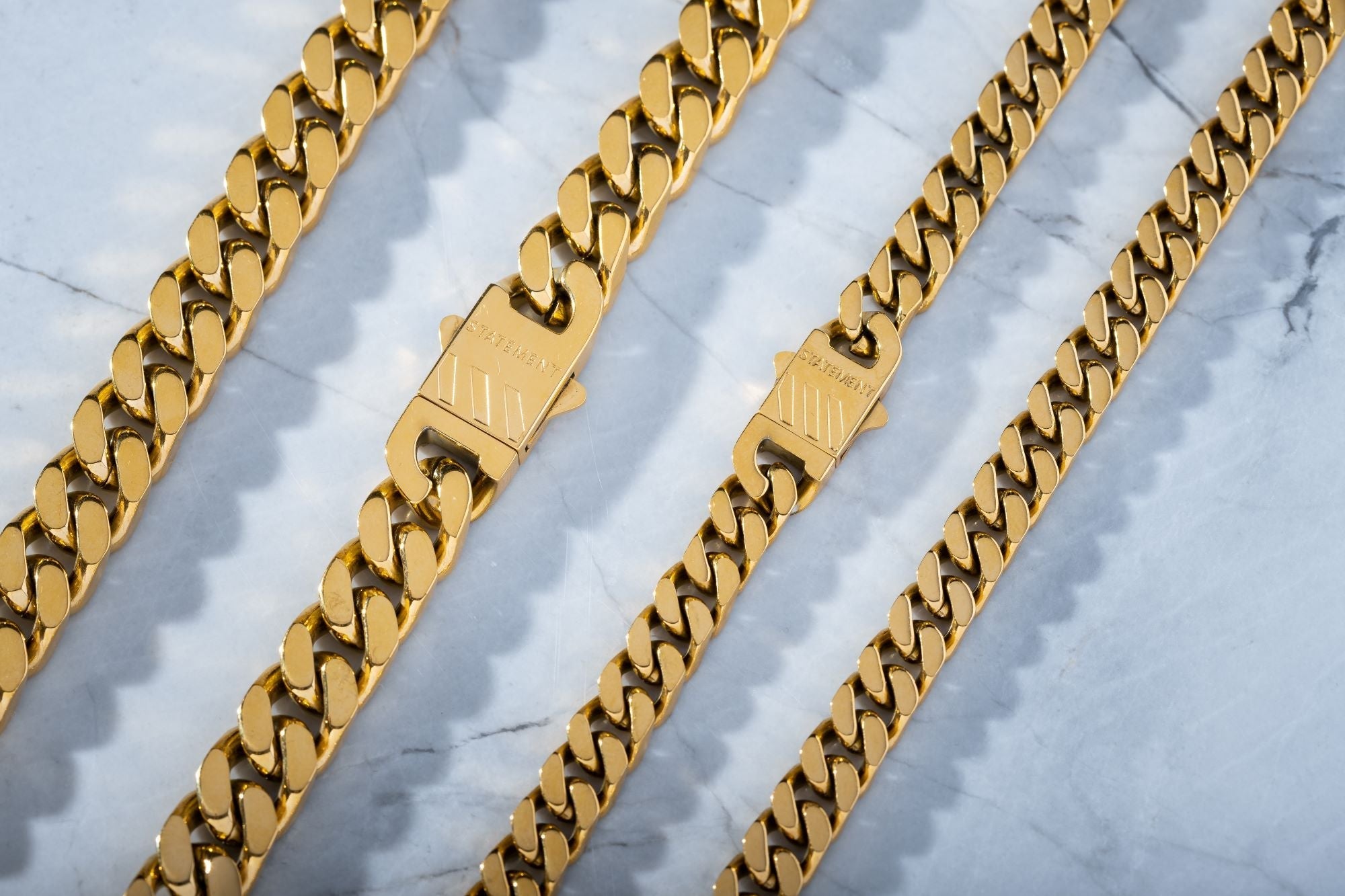
The metal type is the same (e.g., 14k gold), but the link style changes the durability. Cuban links and Rope chains are solid and sturdy. Herringbone and Omega chains are often flat and prone to kinking, making them harder to repair.
Is white gold real gold?
Yes. It is real gold mixed with white metals. It is not "fake," it is just an alloy. However, it requires maintenance (rhodium plating) to keep its bright white colour.
Extended Keyword Glossary
To ensure we cover all bases regarding the types of gold available, here is a quick reference for terms you might encounter.
- Fine Jewellery: Generally refers to jewellery made from 14k gold or higher, set with precious stones.
- Base Metal: The non-precious metal underneath plating (copper, brass, nickel, zinc).
- Ductility: The ability of gold to be pulled into a wire. One ounce of gold can be pulled into a wire 50 miles long.
- Fineness: Another way of expressing purity. 18k is 750 fineness (750 parts per 1000).
- Silver-gilt: An older term for gold vermeil (gold over silver).
- Electroplating: The chemical process used to attach the thin layer of gold in plated jewellery.
- Hypoallergenic: Materials that minimise the risk of an allergic reaction. High karat yellow gold and platinum are the best examples.
Final Tip on Mixing Metals: Don't be afraid to mix gold types. A stack of bracelets mixing yellow, white, and rose gold is a sophisticated look. The old rule of "only wear one colour metal" is dead, and now mixing different gold colours is fashionable. The contrast between the cold white gold and the warm yellow gold contributes depth to a jewellery collection. Just ensure the karats are similar when they rub together so neither scratches the other excessively.